6 Easy Steps to Creating the Perfect Charcuterie Board
Learn how to choose the cheeses and arrange the meats and dips. There's actually a science to it.
Dec 02, 2025
So, you said that you'd bring the cheeseboard. Not to put any pressure on you, but the cheeseboard is a big deal — it's usually the most popular dish at the party. If you're not sure where to start, I'm here to tell you it's as easy as one, two, three (and maybe a few more), and after you've done it once, you'll know how to make acharcuterie boardin to time!
Before you start building, you first need to consider how many people you're going to feed, since that will determine how much food you need and how big your board should be. On average, you should plan to serve one to two ounces ofcheeseand two ounces ofcharcuterieper person if the board is an hors d'oeuvre. If you're serving it as the main course, you're going to want to double the amounts and serve it with plenty of carbs to round out the meal. This can be anything from crackers and fresh-baked bread to nuts and fruit, or even bite-sized snacks likepinchos.
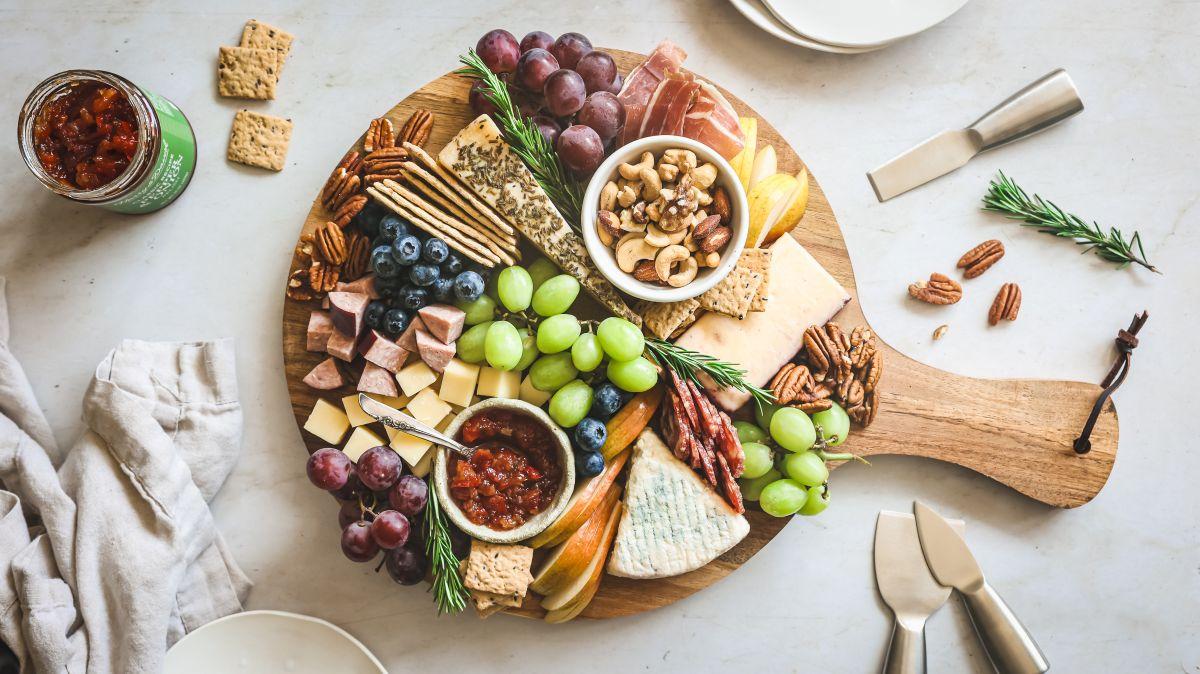
A good rule of thumb is to include a few more types of cheeses than meats, and to scale the variety of cheeses and meats to the size of your board and your party. For a smaller gathering of four to six people, this would look like two to three cheeses and one to two meats, plus fruit, nuts, olives, crackers, jam/honey, and garnish like fresh herbs. If you're serving more people, just add more of everything!
Here's the step-by-step for how to build a charcuterie board.
For this board, I focused my cheese selections on different textures and flavor profiles. The Bayley Hazen Blue, a soft cow's milk cheese, is dense and creamy. Like most blue cheeses, this one is peppery, but also has a grassy, toasted-nut sweetness, giving it a balance of flavors that makes it great for guests who may not have tried blue cheese before. The Harry & David Gouda, a semisoft cow's milk cheese, is known for its caramel-like flavor and is a great option to have on the board for guests who prefer a milder flavor. Finally, the Sartori Rosemary and Olive Oil Asiago, a hard cow's milk cheese, has a rich, fruity, nutty flavor that lends it to pairing well with the crackers and nuts (andchardonnay, if you're servingwine).
On this board, I styled the blue cheese and Asiago on their own. Because of its creaminess and tendency to crumble, blue cheese can't be cleanly cut into smaller pieces and should always be left in a wedge for guests to cut their own servings. I decided to leave the Asiago as a whole wedge too, to serve as a focal point for the board. Lastly, the Gouda was sliced into cubes to distinguish it from the other cheeses and add a different visual to the board. Depending on the amount and types of cheese you serve, you can also cut them into triangles, rectangles, or squares, so that each one stands out on its own.
And there you have it! Time to serve your board. Pair it with a glass ofwineor a seasonalcocktaillike apear mojito.