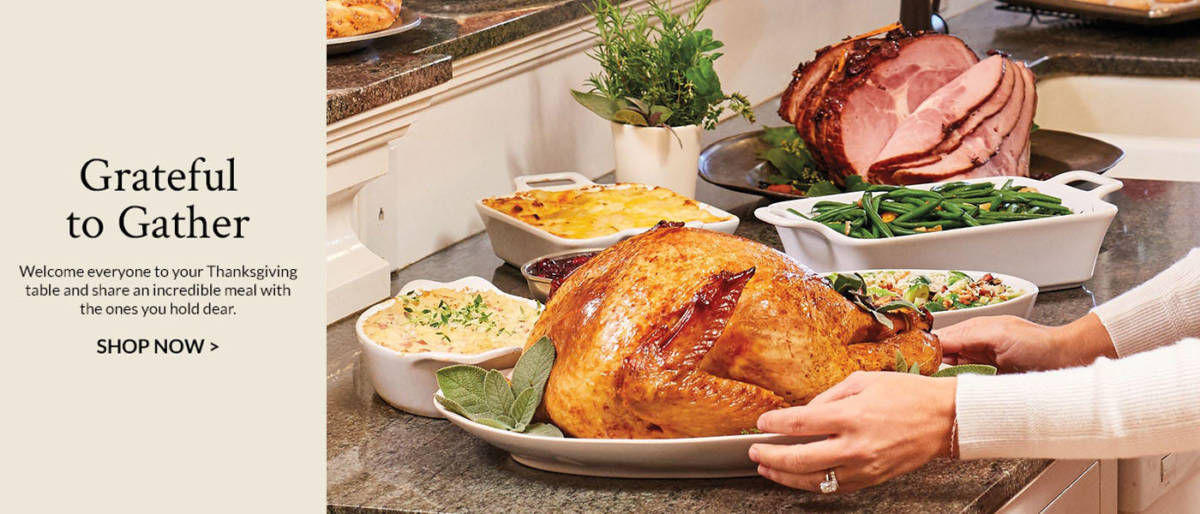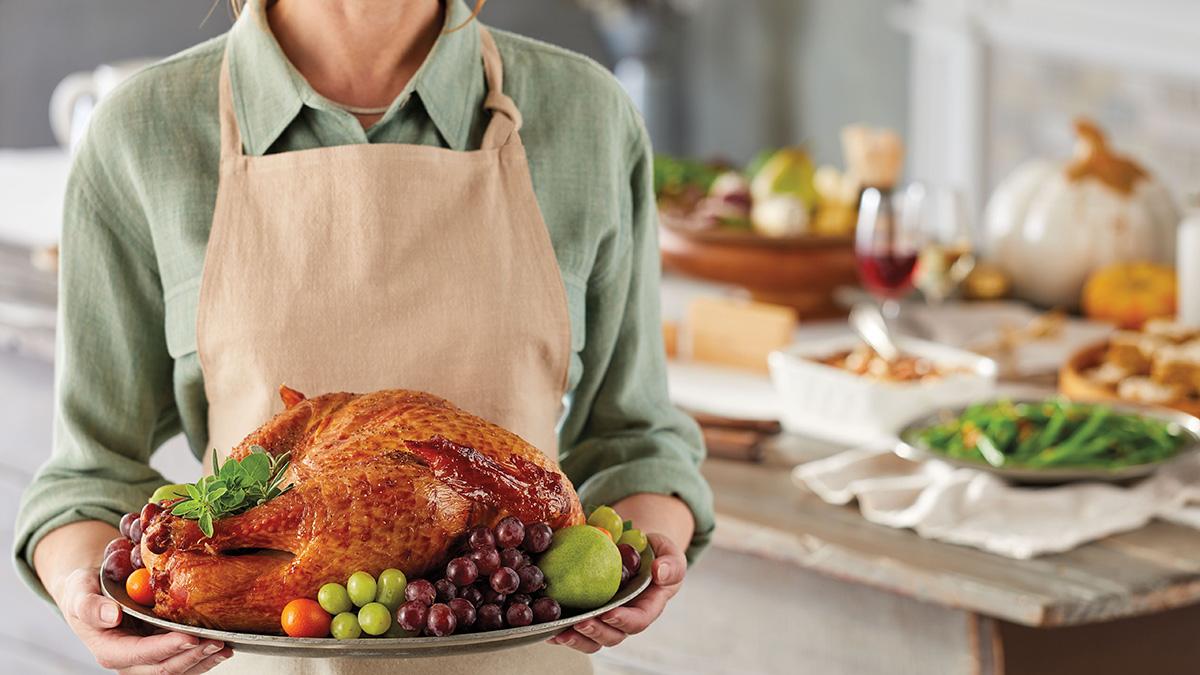
Serving a turkey at the Thanksgiving table means you're doing something more than simply feeding family and friends or honoring anAmerican tradition. The bird is a centerpiece in and of itself, and as this beloved holiday evolves, everything fromwhere you buy the turkeytobuilding a meal around itto what to do with theleftovershas taken on increased significance and meaning.
In other words, it's important to source, cook, and use the turkey the right way. That's why we checked in with Heidi Orrock of Diestel Family Ranch for step-by-step advice on how to carve the turkey and do a whole lot more. Whole Diestel Family Ranch turkeys are available from Harry & David, eithersmokedoroven-roastedand ready to heat. The featured birds are raised on vegetarian feed with no antibiotics or preservatives, so you can feel good about havingThanksgiving dinner deliveredand putting this turkey on your table.
To find the right-sized turkey, Orrock says to plan on roughly 1.5 pounds per person — especially if you want leftovers. So, if you're cooking dinner for eight, buy a 12-pound turkey.
A brief history of eating turkey at Thanksgiving
There are dozens of interpretations of how Americans came to celebrate Thanksgiving. According to theNational Archives, President George Washington issued a public decree for a “day of public thanks-giving" in 1789. In 1863, during the Civil War, President Abraham Lincoln declared the last Thursday in November to be “a day of Thanksgiving." The official holiday was established as the fourth Thursday of November in 1941. The language there was intentional: The last Thursday in November would have fallen on the 30th, and President Franklin D. Roosevelt wanted to avoid a short holiday season during a period of economic recovery.
READ MORE: A Full Serving of Little-Known Facts About Thanksgiving
Because turkeys were plentiful in the Northeast in the late 18th and 19th centuries, it is believed that Americans celebrated these early versions of Thanksgiving with roasted turkey because the birds were big enough to feed a large group of people.
The tradition also traces back to pilgrims' harvest celebrations, which were meant to give thanks for the bounty. Accounts differ about whether turkeys were part of the festivities, but “wild fowl" — along with venison — arementioned(pumpkin pie, sadly, was not), leading to the belief that turkey was served as far back as the 1600s.
Step-by-step guide to carving a turkey
Orrock should know how to carve a turkey: Her family has raised turkeys commercially in the Sierra Nevada foothills of California since 1949. Follow along with our illustrated guide and impress your family and friends with your turkey-carving prowess.
A couple of quick tips before carving: Rest thecooked turkeyfor up to an hour before starting to make sure the juices are sealed in, and carve the turkey in the kitchen rather than at the table.
Leftovers and more!
One of the best tricks of utilizing the whole turkey is to keep a stock pot nearby as you carve and toss in bones, the tips of the wings, and random scraps of meat to make turkey stock for soups. Besides the turkey bones and such, you'll just need to add chopped celery and carrots and water, and simmer until the broth is the right consistency.
Of course, should you have any leftover turkey from the main meal, the meat can be used in all sorts of recipes. The breast, as well as sides like cranberry sauce andstuffing, can make awesome turkey sandwiches. Dark meat from the thighs is rich and flavorful, a perfect protein for zesty turkey enchiladas. Even the leftover vegetables can be transformed, as in theseleftover recipes.
Using up all the parts of the turkey helps eliminate the sort of food waste typically associated with such gatherings, and will make you feel good about your Thanksgiving celebration for days or even weeks to come.
P.S. About that wishbone…
Don't forget to put the wishbone to use. The furcula is a bone in chickens and turkeys between the neck and the breast, with a slight elasticity thought to be instrumental in allowing the birds' wings to flap.
The tradition of drying out the furcula in chickens dates back to pre-Roman times. According toModern Farmer, Etruscans introduced the idea of breaking the wishbone to make predictions, which the Romans and, eventually, the British, picked up.
The wishbone-breaking tradition came to North America with the pilgrims, who used the furcula of the plentiful turkeys. This paved the way for another Thanksgiving tradition: a tug of war with the wishbone, wherein the winner, who is left with the larger piece of the bone, will have good luck.